HOME
TITLE INDEX
SPECIAL EDUCATION
COUNSELING
SOCIAL WORK
JOURNALS
EXAM COPIES FOR FACULTY
BOOK PROPOSALS
ORDER INFORMATION
FREE CATALOG
RETURN AUTHORIZATION
ORDER FORM
ADDRESS
   
Special Education > Teaching Special Children in Regular Classrooms
Love Publishing
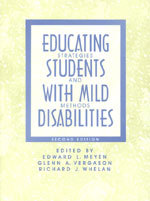
>EDUCATING STUDENTS WITH MILD DISABILITIES
Strategies and Methods • Second Edition
Edward L. Meyen, University of Kansas
Glenn A. Vergason, Georgia State University
Richard J. Whelan, University of Kansas

This book discusses the best instructional practices for teaching students with mild disabilities. It provides both general and special education teachers with the latest up-to-date strategies. You'll find curriculum considerations in an inclusive environment and specific interventions. It is empirically based and translates the latest research into classroom practice. It includes learning strategies, curriculum based measurement, assessment, co-teaching, and much, much more.

Special Features

  • Addresses all of the cutting edge issues in teaching students with mild disabilities
  • Includes learning disabilities, behavior disorders, and mildly retarded
  • Empirically based instructional information for effective teaching
  • Designed for both general education and special education students
  • Highly practical and translates research into classroom practice

Contents

Part One: Managerial Strategies

1. Discipline in Special Education and General Education Settings
2. The Missing Link: Students Discuss School Discipline
3. Courage for the Discouraged: A Psychoanalytical Approach to Troubled and Troubling Children
4. Management of Aggressive and Violent Behavior in Schools
5. Classroom Interventions for Students with Attention Deficit Disorders
6. Behavior Management in Inclusive Classrooms

Part Two: Curriculum Strategies

7. Preferred and Promising Practices for Social Skills Instruction
8. Elementary School Science for Students with Disabilities
9. Teaching Students with Learning Problems in Math
10. Strategies for Teaching Social Studies
11. Curriculum Considerations in an Inclusive Environment
12. Curriculum and Instructional Issues in Teaching Secondary Students with Learning Disabilities
13. A Focus on Curriculum Design: When Children Fail

Part Three: Instructional Strategies

14. Best Academic Practices for Inclusive Classrooms
15. Peer-Mediated Instruction and Interventions
16. Secondary Inclusion Programs for Students with Mild Disabilities
17. Curriculum-Based Collaboration
18. Teaching Concepts: Procedures for the Design and Delivery of Instruction
19. Educational Interventions for Students with Attention Deficit Disorder
20. Co-Teaching: Guidelines for Creating Effective Practices

500 pages
1998/paperback/ISBN 0-89108-253-0
$54.00


Love Publishing
>TEACHING SPECIAL LEARNERS IN THE GENERAL EDUCATION CLASSROOM
Methods and Techniques • Second Edition
Kathleen M. McCoy, Arizona State University

The target audience for this text is elementary teachers, both general and special, and the emphasis is on academic instructional strategies. The contents provide step-by-step suggestions to assist a general education teacher in inclusive settings.

Special and general educators need information that will help them teach all their students in the general education classroom. Teaching Special Learners in the General Education Classroom meets that need by presenting workable, proven methods. It includes practical guidelines and strategies that work so teaching is made easier.

Special Features

  • Covers planning, assessment, and groupings
  • Noncategorical with dozens of teaching methods and curricular modifications
  • Vignettes and activities are sprinkled throughout the book
  • Includes programming and intervention methods
  • Step-by-step suggestions to work with special children in the general education classroom
  • Addresses the inclusion movements
  • Packed with dozens of ideas and tips for managing classroom time

Contents

1. A Modern Fable
2. Mainstreaming and Inclusion Movements
3. Children with Mild to Moderate Learning Problems
4. Children with Physical, Visual, and Hearing Disabilities
5. The Individualized Education Program
6. Classroom Organization
7. Pinpointing Reading Skill
8. Reading Methods
9. Reading for Special Populations
10. Language Arts
11. Mathematics Skills Evaluation
12. Mathematics Instruction
13. Accommodation through Technology

Instructors Manual
484 pages
1995/hardback/ISBN 0-89108-238-7
$56.00


Love Publishing
> STRATEGIES FOR TEACHING EXCEPTIONAL CHILDREN IN INCLUSIVE SETTINGS
Edward L. Meyen, University of Kansas
Glenn A. Vergason, Georgia State University
Richard J. Whelan, University of Kansas-Medical Center

This highly practical book translates research into classroom practice. You'll find new ideas to help teachers develop effective instructional strategies, including curriculum, assessment, classroom management, and collaboration.

Designed for both general education students and those preparing to be special educators, the text will help teachers to work with special needs students in the inclusive classroom.

Special Features

  • Empirically based instructional strategies for effective teaching
  • Provides procedures for conflict resolution and classroom control
  • Covers the relationship between consultation and collaborative problem solving
  • Addresses all of the cutting edge assessment issues
  • Discusses strategies for teaching thinking skills to students with mild disabilities
  • Examines new approaches to inclusion

Contents

Part One: Curriculum and Instruction

1. Curriculum Considerations in an Inclusive Environment
2. A Focus on Curriculum Design: When Children Fail
3. Standards for All American Students
4. Curriculum-Based Collaboration
5. Considerations in Teaching Higher Order Thinking Skills to Students with Mild Disabilities
6. Searching for Validated Inclusive Practices: A Review of the Literature
7. Co-Teaching: Guidelines for Creating Effective Practices

Part Two: Assessment

8. Classification and Dynamic Assessment of Children with Learning Disabilities
9. Performance Assessment and Special Education: Practices and Prospects
10. Curriculum-Based Measurement and Problem-Solving Assessment: Basic Procedures and Outcomes
11. Current Dimensions of Technology-Based Assessment in Special Education
12. Portfolio Assessment and Special Education Students

Part Three: Classroom Management

13. Peacemakers: Teaching Students to Resolve Their Own and Schoolmates' Conflicts
14. Constructive Classroom Management
15. Discipline in Special Education and General Education Settings
16. Classroom Influences on Aggressive and Disruptive Behaviors of Students with Emotional and Behavioral Disorders

Part Four: Collaboration

17. Practical Questions About Collaboration Between General and Special Educators
18. A Collaborative Model for Students with Mild Disabilities in Middle Schools
19. The General Education Collaboration Model: A Model for Successful Mainstreaming
20. Rethinking the Relationship Between Consultation and Collaborative Problem-Solving

480 pages
1996/paperback/ISBN 0-89108-244-1
$54.00

     
Copyright © 2006 Love Publishing Company - All rights reserved.
This material may not be published, broadcast, rewritten or redistributed in any form.
Site last modified on September 22, 2006