HOME
TITLE INDEX
SPECIAL EDUCATION
COUNSELING
SOCIAL WORK
JOURNALS
EXAM COPIES FOR FACULTY
BOOK PROPOSALS
ORDER INFORMATION
FREE CATALOG
RETURN AUTHORIZATION
ORDER FORM
ADDRESS
   
Special Education > Curriculum
Love Publishing
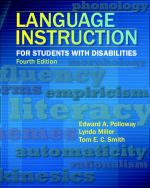
>LANGUAGE INSTRUCTION FOR STUDENTS WITH DISABILITIES • Third Edition
Edward A. Polloway
Lynda Miller
Tom E. C. Smith

This proven resource has become an essential text for language teachers due to its extensive coverage of language development and linguistic diversity, and its practical stratagies. Now, this edition has been updated to reflect the latest cultural issues, language arts curriculum, and teaching innovations.

Individual chapters detail the nature of reading and its assessment, handwriting, spelling, compositional skills, and instructional considerations for adolescents with disabilities. You'll also find suggestions for homework, and ideas for family experiences and much, much more to help students with disabilities learn to communicate more effectively.

You are invited to open this book and see why it is the best-selling text for language instruction for students with disabilities. It is a complete revision, and your students will find it to be an engaging experience.

Special Features

  • Addresses the important role of cultural diversity in language acquisition.
  • Provides specific effective assessment activities and curriculum strategies.
  • Covers language assessment and instruction from preschool through adolescence.
  • Presents powerful strategies to conquer language difficulties.
  • Includes a new companion Web site to enhance student learning.

Contents

Part One: Introduction

1. Introduction to Language, Speech, and Communication
2. Language Development From Infancy Through Adolescence
3. Cultural Diversity and Language Differences

Part Two: Oral Language Assessment and Intervention: Preschool, Elementary, and Secondary

4. Language Assessment and Instruction for Preschool Children
5. Language Assessment and Instruction for School-Age Children
6. Language Assessment and Instruction for Adolescents

Part Three: Language Arts Instruction

7. Reading Concepts and Assessment
8. Reading Instruction
9. Handwriting Assessment and Instruction

10. Spelling Assessment and Instruction
11. Written Expression
12. Adolescents and Language Disabilities

532 pages
2004/ISBN: 0-89108-298-0/Instructor's Manual
$74.00


Love Publishing
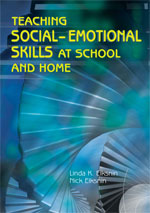
>TEACHING SOCIAL-EMOTIONAL SKILLS AT SCHOOL AND HOME

Linda K. Elksnin and Nick Elksnin

Teaching Social–Emotional Skills at School and Home is designed to provide teachers and parents with strategies for teaching children and youth to become socially and emotionally competent.

This book is research-based yet practical and easy to read. The authors examine all aspects of social–emotional learning, including emotional literacy, social problem solving, and the social skills essential for making friends and succeeding in school—making this text the most comprehensive available.

Readers will learn how to teach social–emotional skills at the individual, classroom, schoolwide, and districtwide levels by integrating instruction within the academic curriculum and how to make social–emotional learning part of school and family life.

Special Features

  • Includes assessment approaches to identify children who need social–emotional skills instruction
  • Contains practical activities to help children of all ages understand and regulate emotions, make and keep friends, solve social problems, and succeed in school
  • Addresses the importance of social–emotional skills for gaining and maintaining employment
  • Incorporates real-life vignettes that connect theory and practice
  • Provides numerous useful forms, checklists, and planning sheets

Contents

  1. The Importance of Social–Emotional Competence
  2. Identifying Children and Youth Who Need Social–Emotional Skills Instruction
  3. Teaching Children and Youth to Understand and Regulate Emotions
  4. Teaching Children and Youth Social–Emotional Problem-Solving Strategies
  5. Teaching Children and Youth Peer-Pleasing Social–Emotional Skills
  6. Teaching Children and Youth Teacher-Pleasing Social–Emotional Skills
  7. Teaching Occupational Social–Emotional Skills
  8. Parents as Teachers
  9. Getting Children and Youth to Use Social–Emotional Skills
Appendix A: Books for Parents, Children & Youth, and Teachers & Administrators
Appendix B: Children’s Books Chosen by Children

0603/352 pages/2006
Paperback
ISBN 0-89108-316-2
$56.00


Love Publishing
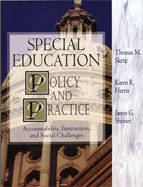
>SPECIAL EDUCATION POLICY AND PRACTICE: ACCOUNTABILITY, INSTRUCTION, AND SOCIAL CHALLENGES
Thomas M. Skrtic, University of Kansas
Karen R. Harris, University of Maryland
James G. Shriner, University of Illinois

This is an excellent book that addresses the policy shift in special education from procedural compliance to standards-based accountability and the changing conditions of practice under reform. It covers the major problems of implementing reform and presents several practices and models to improve the conditions of special education practice.

The authors support a collaborative environment for service delivery and inclusive work atmospheres with research-based instructional practices.The book gives prevention and intervention strategies including specific reading, writing, and mathematics instructional techniques. Other topics include transition, self-determination, school violence, health needs, and literacy instruction for Latino students.

The focus in the last part of the book is oriented to human needs and opportunities that will shape special education practice in the future including individual and environmental conditions.These include welfare of children working across social contexts and providing a planning framework for achieving integrated services.

Special Features

  • Clear explanation of policy shifts from procedural compliance with federal and state law to academic performance of students with disabilities
  • Recommends strategies for improving academic learning for students with disabilities
  • Considers human needs and environmental conditions that contribute to educational achievement of children
  • Provides an action-oriented planning framework for achieving integrated services

Contents

1. The Context of Special Education Practice Today

Part One: Standards-Based Reform and the Conditions of Practice

2. The IDEA Amendments of 1997 and the Conditions of Practice

3. Standards-Based Reform and Students with Disabilities

4. To Ensure the Learning of Every Child with a Disability

5. Special Education Teacher Supply and Teacher Quality

6. Access of Adolescents with Disabilities to General Education Curriculum

7. Supporting Beginning Special Education Teachers

8. Collaboration to Support Students’ Success

9. Students with Disabilities and Paraprofessional Supports

Part Two: Prevention and Intervention Strategies

10. Crossing Boundaries:What Constructivists Can Teach Intensive-Explicit Instructors and Vice Versa

11. Balanced Literacy Instruction

12. Self Regulated Strategy Development in the Classroom:A Balanced Approach to Writing Instruction for Students with Disabilities

13. Balanced Perspectives on Mathematics Instruction

14. Searching for the Best Model for Instructing Students with Learning Disabilities

15. Fostering the Literacy Development of Latino Students

16. Post-Secondary Education and Transition Services for Students Ages 8–21 with Significant Disabilities

17. Self-Determination and Quality of Life

18. Supporting Students with Health Needs in Schools

19. School Violence and Disruption

Part Three: Risk, School, and Society

20. Risk, Families, and Schools

21. Integrating Services, Collaborating, and Developing Connections with Schools

592 pages
2004
Paperback/ISBN 0-89108-310-3
$70.00


Love Publishing
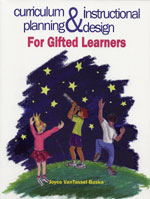
>CURRICULUM PLANNING AND INSTRUCTIONAL DESIGN FOR GIFTED LEARNERS
Joyce VanTassel-Baska – College of William and Mary

This comprehensive text establishes an exciting curriculum design model that caters to the unique needs of the gifted learner. While giving careful consideration to the current climate of educational reform, the text is able to preserve and enhance the invaluable enterprise of gifted education.

The author’s extensive experience in the field of gifted education makes this text an invaluable resource for students and teachers alike. Ambitious and impressive in scope, the text gives thorough attention to crucial issues such as effective curriculum delivery, implementation strategies, and learner-outcome assessment.

Special Features

  • Provides a comprehensive framework for curriculum planning.
  • Designs an effective planning model for instruction.
  • Outlines specific instructional strategies and curriculum units.
  • Presents guidelines for learning assessment and curriculum evaluation

Contents

1. Introduction
2. Research on Curriculum Models in Gifted Education
3. Standards of Learning and Gifted Documents
4. Developing System-Wide Curriculum Documents
5. The Nature of Curriculum Needs of Gifted Learners
6. Developing a Philosophy and Goals for a Gifted Program
7. Developing Learner Outcomes
8. Designing Activities and Selecting Resources
9. Selecting Instructional Strategies
10. Employing Appropriate Curriculum Management Strategies
11. Implementing Curricula for the Gifted
12. Assessment of Learning and Evaluation of Curriculum
13. Toward Coherent Curriculum Policy in Gifted Education
Appendix: Sample Curriculum Units

360 pages
2003/paperback/ISBN 0-89108-292-1
$56.00


Love Publishing
>EFFECTIVE CURRICULUM FOR STUDENTS WITH EMOTIONAL AND BEHAVIORAL DISORDERS
Beverley Johns, Garrison Alternative School, Jacksonville, IL
E. Paula Crowley, Illinois State University
Eleanor Guetzloe, University of South Florida

This book is designed to show how to create specialized instruction based on the individualized needs of students with emotional and behavioral disorders. The book demonstrates throughout how to plan a curriculum based on a diagnostic prescriptive approach.

The authors stress that teachers must know as much as possible about each student. This includes strengths, deficits, interests, and behavioral functions. Teachers can then plan an appropriate program based on effective, direct instructional approaches.

Special Features

  • Shows both social and academic interventions.
  • Includes ideas for becoming partners with community agencies.
  • Gives techniques for planning communication with parents.
  • Helps teachers to plan engaged time in learning activities.

Contents

  1. The Teacher as a Catalyst for Change
  2. Assumptions Underlying Quality Educational Programming
  3. Life Skills and Transition to Adulthood
  4. Role of the IEP in Education of Students With E/BD
  5. Meaningful and Relevant Curriculum
  6. The Central Role of Teaching Social Skills
  7. Multicultural Education for Students With E/BD
  8. Curriculum of Hope: Focusing on Helping Others
  9. Engaged Time in the Classroom
  10. Student Self-Management
  11. Higher-Level Thinking Skills
  12. Learning Strategies and Study Skills
  13. Access to the General Curriculum
  14. Effective Inclusion of Students With E/BD
  15. Working With Families of Students With E/BD

256 pages
2002
paperback/
ISBN 0-89108-287-5
$39.95


Copyright © 2006 Love Publishing Company - All rights reserved.
This material may not be published, broadcast, rewritten or redistributed in any form.
Site last modified on June 29, 2008