|
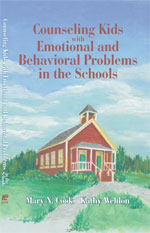
| >COUNSELING KIDS WITH EMOTIONAL AND BEHAVIORAL PROBLEMS IN THE SCHOOLS |
|
Mary N. Cook and Kathy Weldon
Counseling Kids With Emotional and Behavioral Problems in the Schools is a comprehensive text on counseling in a user-friendly format that makes it a joy for those who work with children with emotional and behavioral problems.
Cook and Weldon explore different emotional and behavioral problems and the children who exhibit them, including children who are depressed, unsafe, socially impaired, anxious, selectively mute, school-refusing, disruptive or ADHD, and difficult. The book also examines working with classes or groups, as well as crisis intervention from the counselor’s perspective.
Categorized by emotional or behavioral difficulty, each chapter dissects the epidemiology and major characteristics of the problem, assessment techniques, and interventions. The text relates countless scenarios, dialogues, and case studies and provides activities, games, and sample behavioral contracts to be used by counselors, teachers, and parents.
Special Features
- Provides essential information and statistics about each emotional or behavioral problem
- Emphasizes practical and usable strategies to effect change in children
- Includes three appendices with more than 40 blackline masters to be used around the office, classroom, or home
Contents
- The Depressed Child: What to Do With Kids Who Are Sad
- The Unsafe Child: What to Do With Kids Who Threaten to Harm Themselves or Others
- The Socially Impaired Child: What to Do With Kids Who Can’t Get Along With Others
- The Anxious Child: What to Do With Kids Who Worry Too Much
- The Selectively Mute Child: What to Do With Kids Who Won’t Talk at School
- The School-Refusing Child: What to Do When Kids Won’t Go to School
- The Disruptive or ADHD Child: What to Do When Kids Won’t Sit Still and Be Quiet
- The Difficult Child: What to Do When You’ve Tried Everything
- Working With Groups or Classes: How To Intervene With More Than One Child
- Crisis Intervention: How to Intervene in the Face of Tragedy
- Appendix A: Techniques for Counseling Socially Impaired Children
- Appendix B: Techniques for Counseling Anxious Children
- Appendix C: Techniques for Counseling Disruptive Children
- Appendix D: Sample Behavioral Contracts
0501/176 pages/2006
Paperback
ISBN 978-0-89108-313-9
$32.00
|
|
|
|
|
|
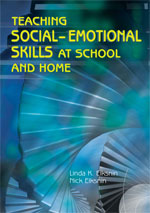
| >TEACHING SOCIAL-EMOTIONAL SKILLS AT SCHOOL AND HOME |
|
Linda K. Elksnin and Nick Elksnin
Teaching Social–Emotional Skills at School and Home is designed to provide teachers and parents with strategies for teaching children and youth to become socially and emotionally competent.
This book is research-based yet practical and easy to read. The authors examine all aspects of social–emotional learning, including emotional literacy, social problem solving, and the social skills essential for making friends and succeeding in school—making this text the most comprehensive available.
Readers will learn how to teach social–emotional skills at the individual, classroom, schoolwide, and districtwide levels by integrating instruction within the academic curriculum and how to make social–emotional learning part of school and family life.
Special Features
- Includes assessment approaches to identify children who need social–emotional skills instruction
- Contains practical activities to help children of all ages understand and regulate emotions, make and keep friends, solve social problems, and succeed in school
- Addresses the importance of social–emotional skills for gaining and maintaining employment
- Incorporates real-life vignettes that connect theory and practice
- Provides numerous useful forms, checklists, and planning sheets
Contents
- The Importance of Social–Emotional Competence
- Identifying Children and Youth Who Need Social–Emotional Skills Instruction
- Teaching Children and Youth to Understand and Regulate Emotions
- Teaching Children and Youth Social–Emotional Problem-Solving Strategies
- Teaching Children and Youth Peer-Pleasing Social–Emotional Skills
- Teaching Children and Youth Teacher-Pleasing Social–Emotional Skills
- Teaching Occupational Social–Emotional Skills
- Parents as Teachers
- Getting Children and Youth to Use Social–Emotional Skills
- Appendix A: Books for Parents, Children & Youth, and Teachers & Administrators
- Appendix B: Children’s Books Chosen by Children
0603/352 pages/2006
Paperback
ISBN 978-0-89108-316-0
$58.00
|
|
|
|
|
|
| >COUNSELING CHILDREN AND ADOLESCENTS • Fourth Edition |
| Ann Vernon
This new edition has been revised considerably to include even more practical information and “how to” strategies for counseling children and adolescents, as well as for working with families and parents. The authors present numerous empirically based approaches that are developmentally and culturally appropriate for counseling children.
This text offers helpful information on the individual and group counseling process and includes a plan for designing a developmental counseling curriculum from primary grades through high school. Comprehensive, up-to-date chapters specifically address counseling children who are at risk or who have special needs and children and adolescents from diverse backgrounds. Chapters on play therapy, rational–emotive behavior therapy, and brief therapy specifically describe how to apply these approaches with children and adolescents.
The rich experiences of the authors as both practitioners and clinicians, in addition to being counselor educators, bring a wide array of innovations and creative techniques to this new volume.
512 pages
0901/Hardcover/ISBN 978-0-89108-340-5
$90.00
|
|
|
|
|
|
>FREE APPROPRIATE PUBLIC EDUCATION:
The Law and Children with Disabilities • Seventh Edition |
H. Rutherford Turnbull III, Matthew J. Stowe, and Nancy E. Huerta
Now, a total revision of the classic book dealing with the law governing the education of children with disabilities is ready for educators. It includes the 2004 IDEA reauthorization and the proposed regulations. This up-to-the-minute resource brings you the most recent developments in legislation, case law techniques, due process, parent participation and much, much more.
The text is completely updated and contains all the substantial amendments made by the latest reauthorization of IDEA. It includes a glossary and other resources to bring the best possible information to students and professionals.
This book is essential reading for any course dealing with school law or school administration. All school principals and special education teachers should have this new resource on their desk.
Special Features
- Completely updated with amendments made by the latest reauthorization
- Includes all the significant cases
- Examines ways to understand the legal challenges
- Presents ideas to help parents and schools work together
Contents
Part 1: Introduction to the American Legal System and Education
and Related Laws
1. Introduction to American Legal System
2. Federal Disability Policy
3. IDEA, Anti-Discrimination Laws, and General Education Law
Part 2: Six Principles of IDEA
4. Zero Reject
5. Non-Discriminatory Evaluation
6. Individualized and Appropriate Education
7. Least Restrictive Environment
8. Procedural Due Process
9. Parent Participation
Part 3: Enforcement and Core Concepts
10. Enforcement
11. Core Concepts
448 pages
2007/hardback/ISBN 978-0-89108-325-2
$82.00 |
 |
 |
|
|
|
|
>TECHNIQUES FOR MANAGING VERBALLY AND PHYSICALLY AGRESSIVE STUDENTS
Third Edition |
|
Beverley Johns
Valerie Carr
The latest edition of this classic book incorporates new strategies for handling violence and inappropriate behavior in our schools, including the implications of new technologies like cell phones, social networking, and cyberbullying. The authors provide how-to information and step-by-step methods for working with disciplinary problems and aggression within the school setting. It focuses specifically on techniques for breaking up fights, intervening in bullying, and working with students who talk back and refuse to do their work.
These classroom management techniques provide tangible results. Strategies for school-wide behavior management and community and parent involvement provide an integrated and comprehensive approach to addressing violence in our schools.
Contents
1. Facing the Challenge
2. The Classroom Climate
3. Ineffective Classroom Management Techniques
4. Successful Behavior Management
5. Behavioral Intervention Plans
6. Understanding Aggression
7. Dealing With Aggressive Behavior
8. Verbally Dealing With Aggression
9. Use of Time-Out
10. Bully-Proofing Your Classroom
11. Dealing With Physical Aggression
12. Breaking Up Fights
13. Police Intervention and Community Agency Involvement
14. Working Effectively With Parents
15. Administrative Issues
194 pages
paperback/ISBN 978-0-89108-342-9
$39.95 |
|
|
|
|
|
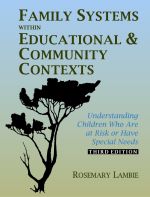
>FAMILY SYSTEMS WITHIN EDUCATIONAL AND COMMUNITY CONTEXTS
Understanding Children Who Are at Risk or Have Special Needs • Third Edition |
|
Rosemary Lambie
The third edition emphasizes at-risk children and those with special needs, and it includes a new chapter on violence and bullying in schools and communities. Every chapter has been extensively updated to reflect current literature and thinking. The content provides a wider systemic view of how professionals and family members can better serve children who are at risk for failure in school or in life.
This book explains major concepts and research findings on the family life cycle, family interactions, and other environmental factors that may affect children. It examines special populations, including families of divorce and remarriage as well as abusive or addictive families, and it provides specific strategies for working with these special children and their families. The applications section includes strategies, concrete exercises, and interventions.
Special Features
- Case Examples throughout the text
- Suggests interventions within the school system
- Discusses a wide range of families with special attention to diversity
- Develops pragmatic approach to understanding application of family systems concepts
- New chapter on bullying and violence in schools
Contents
Part 1: Description of Family Systems
Chapter 1: Introduction to the Family and Family Systems
Chapter 2: Family Life Cycle
Chapter 3: Family Interaction Patterns
Chapter 4: Historical Factors in Family Systems
Part 2: At-Risk Children, Resilient Children, and Children With Special Needs
Chapter 5: Socioeconomic and Cultural Factors in Families
Chapter 6: Families and Adoption
Chapter 7: At-Risk Children From Nontraditional Families
Chapter 8: At-Risk Children From Challenged Families
Chapter 9: Bullying and Violence in Schools and Communities
Chapter 10: Community Factors in Resilience
Part 3: Application of Family Systems
Chapter 11: Team Functioning and Family Involvement
Chapter 12: Family Conferences and Teacher–Student Support Teams
Chapter 13: Family-Focused Interventions and Individualized Education Programs
Chapter 14: Classroom and Group Extension of Family Systems Concepts
Chapter 15: Strengthening the Possibilities for a Systems Paradigm
- Appendix: Conceptual Frameworks of Family Systems Models
578 pages
Paperback
ISBN 978-0-89108-326-9
$88.00
|
|
|
|
|
| >SCHOOL VIOLENCE AND CHILDREN IN CRISIS • Community and School Interventions for Social Workers and Counselors |
| Joshua Miller, Irene R. Martin, and Gerald Schamess, Smith College School for Social Work
This text uses a holistic approach to show how schools, families, and community agencies can build partnerships to reduce school violence. The book examines various theoretical perspectives to facilitate understanding of the etiology and consequences of school, family, and community violence. The authors cover crisis teams, teacher interventions, debriefing, group psychotherapy, and building partnerships for success. The final part of this text presents community interventions, suggesting that community-based clinical social workers take leadership in collaborations to build systems of care.
This effective resource provides practical insight into the emerging culture of violence in our schools and is specially designed to help school social workers, counselors, and community leaders address this critical issue.
Contents
Part I: Children and Violence: Theoretical Perspectives
1. Why Our Children Turn Violent and How We Can Save Them
2. When Home Isn’t Safe: Children and Domestic Violence
3. Witnessing Violence: The Effects on Children and Adolescents
4. School Violence and Disruption: Rhetoric, Reality, and Reasonable Balance
5. Societal Neglect and Abuse of Children
Part II: Interventions in Schools
6. Uncovering the Hidden Causes of Bullying and School Violence
7. Teaching Children to Care Rather Than Kill
8. School-Based Violence Reduction Programs: A Selective Review of Curricula
9. Using a Group Psychotherapy Framework to Address School Violence
10. Escalation-De-Escalation: Teacher Interventions
11. The Use of Debriefings in Schools
12. The Use of Crisis Teams in Response to Violent or Critical Incidents in Schools
13. The Protocol Approach to School Violence
14. Partners for Success: A Collaborative Approach
Part III: Community Responses
15. The Importance of a Community Response to Violence
16. Constructing a Community Response to Violence
17. Reflections on Family Traditions
18. Systems of Care: Expanding the Response to School Violence
19. Community Mental Health in Practice
336 pages
2003/Paperback/ISBN 978-0-89108-299-6
$52.00 |
|
|
|
|