|
>INTRODUCTION TO GROUP WORK
Fifth Edition |
| David Capuzzi, Douglas R. Gross, and Mark D. Stauffer
This book provides counselors in educational, mental health, private practice, and rehabilitation settings practical guidelines for facilitating groups. This text goes beyond the adaptation or application of theories of individual counseling to the group work setting. New to the fifth edition are updated chapters addressing ethical/legal considerations in group work, as well as diversity issues in group work. This edition also has an updated section entitled “Group Work in Selected Settings,” which includes chapters on groups in schools, mental health, and rehabilitation settings. Readers will find these changes to be of high interest and helpful in developing an appropriate knowledge and skills base for group work.
Special Features
• A comprehensive overview of major issues connected with group work
• Study guide - Links below
• A combination of research, theory, and practice information
• Case studies
Contents - Click on a chapter for a self help guide
Part One: Foundations for Group Work
1. Group Work: An Introduction
2. Group Work: Stages and Issues
3. Group Work: Elements of Effective Leadership
4. Group Work: Theories and Applications
Part Two: Professional Issues
5. The Efficacy of Group Work
6. Approaches to Evaluating Groups
7. Group Work: Ethical/Legal Considerations
8. Diversity Issues in Group Work
Part Three: Specialty Groups
9. Task/Work Groups
10. Guidance/Psychoeducational Groups
11. Psychotherapy Groups
Part Four: Group Work in Specific Settings
12. Groups in Schools
13. Groups in Mental Health Settings
14. Groups in Rehabilitation Settings
Part Five: Group Work with Specific Populations
15. Group Work: Loss
16. Group Work: Addictions
17. Group Work: The Elderly and Their Caregivers
18. Group Work: Gay, Lesbian, and Bisexual Clients
2009
Hardback / 630 pages
ISBN 978-0-89108-344-3
$94.00
|
|
|
|
|
|
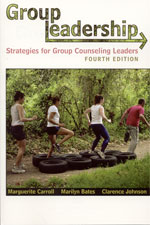
>GROUP LEADERSHIP
Strategies for Group Counseling Leaders
Fourth Edition |
| Marguerite Carroll, Marilyn Bates, Clarence D. Johnson
The main focus of this book is to provide group leaders with the professional tools to activate positive group processes and give members growth-producing experiences. It is developmental rather than remedial and motivated primarily by the growth needs of members. The model is for people who want to expand their personal development and experience growth in a self-actualizing paradigm. The book is highly practical for such diverse settings as probation departments, mental health units, community groups, rehabilitation groups, school settings, and family counseling. The basic premise of the book is that open, honest, and direct communication among human beings is both possible and desirable.
Special Features
- Based on a developmental well model
- Emphasizes open communication strategy
- Trains group leaders to handle positive group processes
- Presents verbal and nonverbal activities
CONTENTS
- Introducing the Developmental Base
- The Philosophical Base of the Developmental Group Model
- Patterns of Interaction: Individual Behavior in the Group
- Leadership Techniques: The Basics
- Developing Good Group Communication Skills
- Pathways to Leadership
- Co-Leadership Issues
- Resistance
- Verbal and Nonverbal Activities
- Developmental Groups in School Counseling
- Training Issues
216 pages
0306/Paper/ISBN 978-0-89108-303-0
$36.00
|
 |
|
|
|
|
>Elements of Group Counseling
Fourth Edition |
| Marguerite R. Carroll and Kurt L. Kraus
The authors of this fourth edition offer essential skills for emerging group leaders. Students and professionals with varied backgrounds in social work, counseling, and psychology will find a host of techniques, practical strategies, and concrete directions for leading groups. The text is intended for courses or workshops in group counseling, group process, and group supervision.
This edition is complete with extensive examples of leadership interventions, how to successfully navigate challenging issues, and establishing obtainable expectations for group members of various ages, settings, and purposes. Elements of Group Counseling provides specific strategies and interventions and is an essential tool and valuable guide for running successful groups.
Productive seating arrangements, ways to encourage members to participate, the length of sessions, approaches for reluctant members, issues of confidentiality, and much, much more are all discussed in this classic work.
Special Features
- Addresses several different types of groups:
- support groups
- school groups
- family groups
- mental health groups
- stress management groups
- Explains the process of leading
- Offers concrete evidence for the effectiveness of the “here and now” approach
- Improves group counseling skills by featuring specific techniques and strategies
CONTENTS
1. Introduction to the Interactional Approach
2. Setting Yourself Up for Success
3. The Here and Now
4. Goals and Legal Issues
5. Leader Interventions
6. Issues for the Leader
7. Working With Young People
8. Co-Leadership: A Question of Choice
Epilogue: A Group Odyssey
ISBN 978-0-89108-322-1
$24.95
|
 |
|
|
|
|
>GROUP WORK
Cybernetic, Constructivism, and Social Constructionist Perspectives |
Raphael J. Becvar, Brian S. Canfield
and Dorothy S. Becvar
This book presents clear and concise explications of modernism, postmodernism, first-order cybernetics, second-order cybernetics/constructivism, and social constructionism and the selected therapeutic approaches consistent with these perspectives.
Contents
1. Cybernetics and Constructivism
2. The Postmodernist and Social Constructionist Perspectives
3. Issues and Dynamics in Group Work
4. First-Order Cybernetics and Group Work
5. More First-Order Cybernetic Models and Group Work
6. Second-Order Cybernetics/Constructivism, Social Constructionism, and Group Work
7. Epistemological, Ethical, and Evaluation Issues
164 pages
1997/paperback/ISBN 978-0-89108-252-1
$29.95 |
 |
|
|
|
|
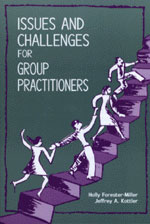
| >ISSUES AND CHALLENGES FOR GROUP PRACTITIONERS |
| Holly Forester-Miller, North Carolina Central University
Jeffrey A. Kottler, California State University, Fullerton
This book gives you new perspectives on being a successful mentor. You’ll find examples of creative art techniques including music, poetry, and movement exercises. Three chapters cover issues about leading groups in organizational settings. The book ends with a discussion of a new theoretical model and narrative groups work.
Special Features
- Explores issues often ignored by traditional texts
- Brings together the best thinking of the gurus of group leadership
- Strong focus on mentoring
232 pages
1997/paperback/ISBN 978-0-89108-251-4
$34.95 |
 |
|
|
|
|
>THE TEAM
Explorations in Group Process |
| Charles Kormanski, Penn State University, Altoona
The Team provides a comprehensive introduction to group process. It is a must for any professional or leader who desires an understanding of task accomplishment through teamwork. The core of The Team is an integration of a series of models and theories to understand the dynamics of change and how a team approach can influence the change process. The text looks at the development of current theory by examining the philosophical underpinnings of group process and theory.
You'll find chapters covering group development stages, change, conflict, leadership style, team building, diversity, applications and much, much more. The pragmatic approach of the book makes each concept and theory easy to understand.
Contents
1. Introduction
2. Group Development Stages
3. Change and Conflict
4. Leadership
5. Leadership Style
6. Team Building
7. Team Member Diversity
8. Team Performance
9. Concluding Thoughts
240 pages
1999/paperback/ISBN 978-0-89108-260-6
$32.00 |
 |
|
|
|