|
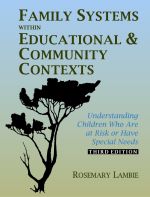
>FAMILY SYSTEMS WITHIN EDUCATIONAL AND COMMUNITY CONTEXTS
Understanding Children Who Are at Risk or Have Special Needs • Third Edition |
|
Rosemary Lambie
The third edition emphasizes at-risk children and those with special needs, and it includes a new chapter on violence and bullying in schools and communities. Every chapter has been extensively updated to reflect current literature and thinking. The content provides a wider systemic view of how professionals and family members can better serve children who are at risk for failure in school or in life.
This book explains major concepts and research findings on the family life cycle, family interactions, and other environmental factors that may affect children. It examines special populations, including families of divorce and remarriage as well as abusive or addictive families, and it provides specific strategies for working with these special children and their families. The applications section includes strategies, concrete exercises, and interventions.
Special Features
- Case Examples throughout the text
- Suggests interventions within the school system
- Discusses a wide range of families with special attention to diversity
- Develops pragmatic approach to understanding application of family systems concepts
- New chapter on bullying and violence in schools
Contents
Part 1: Description of Family Systems
Chapter 1: Introduction to the Family and Family Systems
Chapter 2: Family Life Cycle
Chapter 3: Family Interaction Patterns
Chapter 4: Historical Factors in Family Systems
Part 2: At-Risk Children, Resilient Children, and Children With Special Needs
Chapter 5: Socioeconomic and Cultural Factors in Families
Chapter 6: Families and Adoption
Chapter 7: At-Risk Children From Nontraditional Families
Chapter 8: At-Risk Children From Challenged Families
Chapter 9: Bullying and Violence in Schools and Communities
Chapter 10: Community Factors in Resilience
Part 3: Application of Family Systems
Chapter 11: Team Functioning and Family Involvement
Chapter 12: Family Conferences and Teacher–Student Support Teams
Chapter 13: Family-Focused Interventions and Individualized Education Programs
Chapter 14: Classroom and Group Extension of Family Systems Concepts
Chapter 15: Strengthening the Possibilities for a Systems Paradigm
- Appendix: Conceptual Frameworks of Family Systems Models
578 pages
Paperback
ISBN 978-0-89108-326-9
$88.00
|
|
|
|
|
|
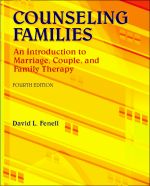
>COUNSELING FAMILIES • Fourth Edition
An Introduction to Marriage, Couple, and Family Therapy |
| David L. Fenell
The fourth edition of Counseling Families has undergone a substantial revision. As in the prior editions the text is concrete, pragmatic, and relevant to aspiring family therapists.
The foundation to the family therapy section is a training process that links individual and group counseling theories and practices to those used in marriage and family therapy. Readers will build their core counseling skills to begin implementing specific family systems intervention models. This edition continues to help students link some of these family systems therapies with psychodynamic, cognitive-behavioral, and humanistic theories.
New to the fourth edition is a focus on the recent developments in the profession. Discussion on the evolving definitions of marriage and the family and the controversies that have emerged from these definitions enhance the family therapy section. Additionally, there are two new chapters in this edition. One chapter advances important skills to prepare competent family therapists. The other new chapter focuses on counseling military families and the demand for marital and family therapy services for returning veterans and their families.
SPECIAL FEATURES
- Website with summaries, lists of key terms, quizzes, and related web links
- Includes a list of institutions that have programs designed to prepare family therapists
- Includes evolving definitions of marriage
- Addresses concerns for of special needs families and military families
CONTENTS
Part One: Foundations of Marriage, Couple, and Family Therapy
- Families and Family Therapy: An Introduction
- The Need for Family Therapy
- The Emergence and Evolution of Marriage, Couple, and Family Therapy
- Current Issues and Trends in Marriage, Couple, and Family Therapy
- The Family as a Living System: Essential Concepts
- Making the Paradigm Shift: Building Bridges from Individual to Family Systems Theories
- Using Core Counseling Skills in Marriage, Couple, and Family Therapy
Part Two: Helping Couples Change with Individual and Systems Theories
- Helping Families Using Psychodynamic Individual Theories
- Helping Families Using Psychodynamic Systems Theories
- Helping Families Using Cognitive-Behavioral Individual Theories
- Helping Families Using Cognitive-Behavioral Systems Theories
- Helping Families Using Interpersonal Individual Theories
- Helping Families Using Interpersonal Systems Theories
Part Three: Special Issues in Marriage, Couple, and Family Therapy
- Counseling Military Families
- Counseling Families with Special Needs
- Research in Marriage, Couple, and Family Therapy
- Professional Issues and Ethics in Marriage, Couple, and Family Therapy
pages
2012 / Paperback / ISBN 978-0-89108-350-4
$82.00
|
|
|
|
|
|
>FAMILY COUNSELING
Strategies and Issues |
| Edited by Jon Carlson and Judith A. Lewis
This revised edition is state-of-the-art and includes important topics such as dual
career couples, interracial couples, military counseling, families with special needs children, addictions counseling, grandparents in the parenting role, and much more. This book is a fresh, lucid approach that will help your students understand the major issues in family dynamics and how to deal with them. This practical and up-to-date work covers major strategies and issues that all professionals need to know about.
Contents
Part One: Introduction to Today's Families
Part Two: Strategies
Part Three: Issues and Challenges
342 pages
2007/paperback/ISBN 978-0-89108-319-1
$56.00 |
 |
|
|
|
|
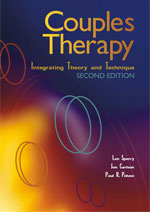
| >COUPLES THERAPY - INTEGRATING THEORY AND TECHNIQUE - Second Edition |
|
Len Sperry, Jon Carlson, and Paul R. Peluso
This new edition is comprehensive, clinically relevant, and thoroughly up-to-date. Since the publication of the first edition fourteen years ago, couples therapy—driven, in part, by managed care’s requirements for accountability—has become increasingly integrative and research-based. This recognition is reflected in a number of new and powerful approaches and methods that are significantly impacting clinical practice and treatment results.
These and other developments are incorporated into the second edition, which is nearly twice as long as the first. Couples Therapy retains a balance between the theoretical and the clinical, with ample description of techniques and methods and compelling case examples that illustrate theory and technique. Mental health professionals, family counselors, social workers, and other professionals will find this book to be a valuable resource in working with the changing pattern of the clinical practice of couples therapy.
Special Features
- Panoramic view of changing social and cultural trends that influence the institution of marriage
- Covers new ideas for resolving distress in intimate relationships
- Includes assessment and intervention strategies that work
- Practical techniques for working with domestic violence, substance abuse, and conflict resolution
- Explores the elements of relational ethics for professionals in the field
Contents
- Psychological and Contextual Factors in Couples Relationships
- Functional and Dysfunctional Couples Relationships
- Biological and Neurological Factors in Couples Relationships
- Insight-Oriented Approaches to Couples Therapy
- Cognitive–Behavioral Approaches to Couples Therapy
- Structural, Strategic, and Other Systemic Approaches to Couples Therapy
- Adlerian and Constructivist Approaches to Couples Therapy
- Affective Approaches to Couples Therapy
- Integrative Approaches to Couples Therapy
- Assessment in Couples Therapy
- Intervention in Couples Therapy
- Clinical Issues in Couples Therapy: Substance Abuse and Domestic Violence
- Clinical Issues in Couples Therapy: Sexual Dysfunction, Separation, and Divorce
- Research and Couples Therapy
- Professional and Ethical Practice of Couples Therapy
- Training, Supervision, Licensure, and the Practice of Couples Therapy in the 21st Century
0602/448 pages/2005
Paperback
ISBN 978-0-89108-315-3
$70.00
|
|
|
|
|
|
| >ESSENTIALS OF FAMILY THERAPY |
William M. Walsh, University of Northern Colorado
James A. McGraw, Longview Community College, Kansas City, Missouri
This text provides a concise overview of several popular systemic approaches to family therapy using a consistent format. This enables readers to quickly identify similarities and differences among the models. The audience will be counseling and social work graduate students in family systems and in marriage and family therapy classes. Clinicians in practice and professionals preparing for licensure examinations will also find this book to be very helpful.
Recent research findings on models of family therapy are included. The first chapter now includes a brief discussion of first- and second- order cybernetic models plus an overview of family therapy outcome research. Each chapter starts with a list of key terms designed to serve as an advanced organizer for readers.
Narrative family therapy has been expanded, along with descriptive summaries of emotionally focused therapy, multi-systemic therapy, and feminist family therapy.
Special Features
- Comprehensive coverage of eight major models of MFT at a glance
- Each model contains same easy-to-read outline format
- Designed to use as review for licensing and graduate comprehensive exams
Contents
- Overview of Family Therapy Models
- Communication/Validation Family Therapy
- Bowenian Theory
- Structural Family Therapy
- Strategic Family Therapy
- Milan Systemic Family Therapy
- Adlerian Family Therapy
- Solution Focused Family Therapy
- Narrative Family Therapy
- Integrative Family Therapy
- Descriptive Summary of Other Models
176 pages
2002
paperback/ISBN 978-0-89108-297-2
$32.00 |
 |
|
|
| >MARITAL THERAPY |
Len Sperry, Barry University
Jon Carlson, Governors State University, Illinois
This classic book covers the changing marital scene with specifics regarding family structure, style of marriage, divorce, remarriage, and child-rearing practices. Social and cultural changes and trends are examined.
The authors suggest a "couple-centered" approach to marital therapy and discuss ways to deal with anger, conflict, and choices, and emphasize the importance of communication skills. The text also addresses the biological and psychosocial dynamics of marriage and introduces theoretical orientations to marital therapy. It provides you with a specific, workable treatment process, including assessment and intervention strategies.
Contents
Part One: Introduction
1. Psychosocial Factors in Marital Functioning
2. Health and Marital Functioning
3. The Nature of Functional and Dysfunctional Marriages
Part Two: Theoretical Approaches to Marital Therapy
4. Psychoanalytic Approaches to Marital Therapy
5. Cognitive–Behavioral Approaches to Marital Therapy
6. Strategic, Structural, and Systemic Approaches to Marital Therapy
7. Integrative Approaches to Marital Therapy
Part Three: Treatment Technique of Marital Therapy
8. The Treatment Process in Marital Therapy
9. Assessment in Marital Therapy
10. Intervention Strategies
11. Common Problems and Issues in Marriage
Part Four: Research and Professional Issues in Marital Therapy
12. Research in Marital Therapy
13. Professional and Ethical Issues
14. Marriage Therapy Case
260 pages
1991/paperback/ISBN 978-0-89108-215-6
$34.95 |
 |
|
|
>HOT CHOCOLATE FOR A COLD WINTER NIGHT
Exercises for Relationship Enhancement |
Dorothy Becvar, St. Louis Family Institute
Ray Becvar, Northeast Louisiana University
This book focuses on marital and couple relationship enhancement with a theoretical base of systems theory. The authors take the position that successful relationships are firmly grounded in strong, caring, nurturing behaviors and thus have focused on ways to facilitate such behaviors with the result that they’ve produced a gem of a book full of exercises to break down barriers and teach lasting skills.
The exercises for interpersonal growth in Hot Chocolate…provide experiences based on realistic situations and make role-playing easy. You'll find exercises on touching, love, grief, conflict resolution, guilt, genograms, and much, much more.
114 pages
1994/paperback/ISBN 978-0-89108-233-0
$14.95 |
 |
|
|
|
|